The Safer Kind of Leverage? Leveraged ETFs vs Borrowing to Invest
Leveraged ETFs are often described as reckless, while borrowing money to buy an ordinary ETF can sound financially respectable. That distinction is largely cosmetic. Both approaches create leverage; the meaningful difference is where the liability sits and what happens after the market falls.
On a +10% index day, a perfect daily 2× ETF gains approximately 20%. The credit-financed ordinary ETF still gains 10%, but applies that return to twice as many invested euros. Both routes turn €10,000 of starting equity into approximately €12,000 before costs—through different mechanics.
A fully paid leveraged ETF can lose nearly its entire value. But it does not leave the shareholder with a personal loan balance. A credit-financed portfolio can lose the invested capital, trigger a forced sale, and still leave a repayment obligation behind.
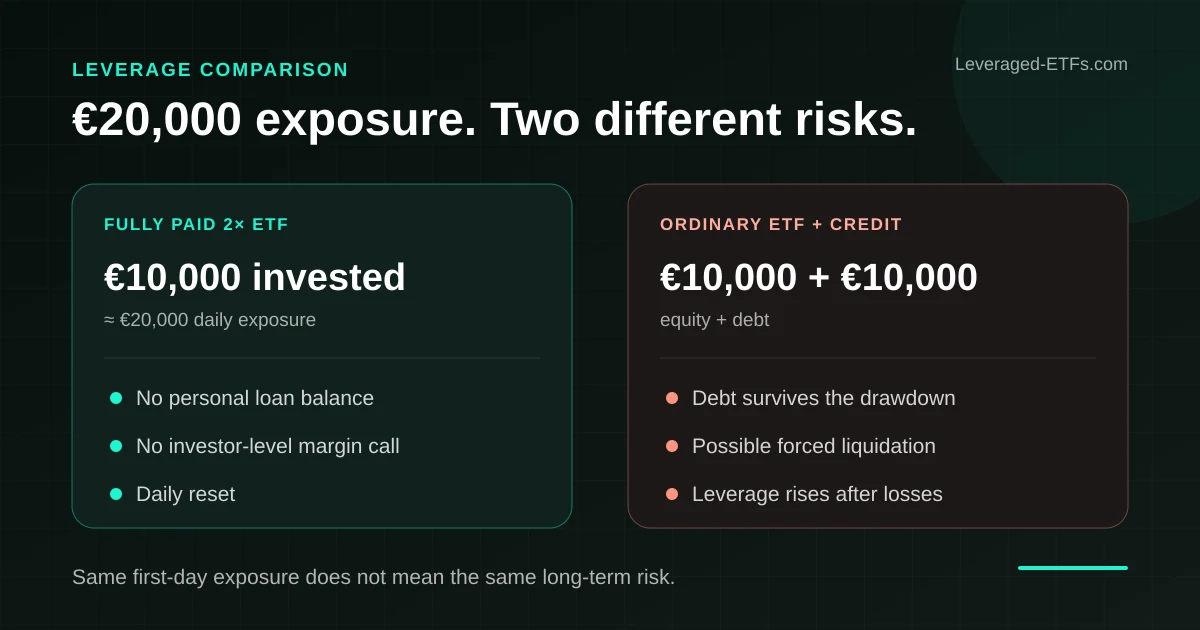
The comparison starts with the same €20,000 exposure
Imagine an investor has €10,000 and wants roughly twice that amount exposed to a broad equity index. One option is to buy €10,000 of a daily 2× ETF. Another is to borrow €10,000 and use the combined €20,000 to buy an unleveraged ETF tracking the same index.
If the index rises 10% on the first day, the perfect 2× ETF gains 20%: €10,000 becomes €12,000. The unleveraged ETF gains only 10%, but the borrowed portfolio owns €20,000 of it: its assets rise to €22,000, and subtracting the unchanged €10,000 loan leaves the same €12,000 of equity.
The negative case works the same way. A 10% index loss produces a 20% loss in the perfect 2× ETF, reducing €10,000 to €8,000. The borrowed portfolio falls from €20,000 to €18,000; after subtracting €10,000 of debt, its equity is also €8,000. That first-day similarity makes the structures look interchangeable. They are not.
| Scenario | Fully paid 2× ETF | Ordinary ETF bought with credit |
|---|---|---|
| Starting position | €10,000 invested; about €20,000 daily exposure | €20,000 ordinary ETF; €10,000 equity and €10,000 debt |
| After a +10% index day | +20% ETF return: €10,000 → €12,000 equity | +10% asset return: €20,000 → €22,000 assets − €10,000 debt = €12,000 equity |
| Next-day exposure after that gain | €24,000 — 2.00× equity | €22,000 — 1.83× equity |
| After a −10% index day instead | −20% ETF return: €10,000 → €8,000 equity | −10% asset return: €20,000 → €18,000 assets − €10,000 debt = €8,000 equity |
| Next-day exposure after that loss | €16,000 — 2.00× equity | €18,000 — 2.25× equity |
Illustration assumes perfect daily 2× exposure and excludes fund expenses, loan interest, financing, taxes, trading costs, spreads, and tracking differences. The gain and loss rows are alternative one-day scenarios.
The same result lasts for one day
After the gain, the leveraged ETF is worth €12,000 and resets around €24,000 of next-day exposure. The borrowed portfolio owns €22,000 of assets against the same €10,000 debt. Its effective leverage has fallen to about 1.83×.
After the loss, the leveraged ETF is worth €8,000 and resets around €16,000 of exposure. The borrowed portfolio still owns €18,000 against €10,000 of debt. Its leverage has silently risen to 2.25× precisely when the investor has less capital available to absorb another decline.
Keeping the credit-financed portfolio at exactly 2× would require borrowing more after gains, selling and repaying debt after losses, and rebalancing every day. In other words, the investor would manually recreate the mechanism inside a daily leveraged ETF.
What the leveraged ETF contains—and what it protects you from
No personal debt created by the fund
When the shares are purchased in cash, the shareholder can lose the amount invested but does not owe the fund additional money because its derivatives lost value. Financing and collateral management happen inside the fund. That is a meaningful boundary between investment risk and a personal repayment obligation.
No investor-level margin call
A broker margin loan uses securities as collateral. If their value falls far enough, the broker may demand more collateral or liquidate positions. Under U.S. margin rules, firms can impose house requirements above regulatory minimums and may sell assets without advance notice. Exact rules and contracts vary by country and broker.
Automatic deleveraging after losses
The daily reset keeps exposure near the stated multiple of current fund value. After a loss, fewer euros remain exposed the next day. That can prevent leverage from mechanically spiralling upward as equity shrinks. The tradeoff is path dependence: repeatedly reducing exposure after losses and rebuilding it after gains can be punishing in a volatile, directionless market.
One position instead of a financing arrangement
The investor buys and sells one listed product rather than maintaining a loan, collateral level, interest payments, and a rebalancing process. Convenience is not safety, but fewer moving parts reduce operational mistakes.
A margin loan and a personal loan fail differently
Broker margin: the investment secures the debt. A market decline can cause a maintenance call or forced sale near the worst point in the drawdown. Losses can exceed the cash originally deposited, and another security in the account may be sold to cover the shortfall.
Personal credit: there is normally no market-based margin call because the ETF is not the broker's collateral. That removes forced liquidation from the brokerage account, not the debt. Interest and scheduled repayments continue even if the investment collapses, and the lender's claim extends beyond the portfolio.
Neither is equivalent to owning a leveraged ETF in cash. One adds liquidation risk; the other adds a fixed claim against future income.
The honest cost comparison
Comparing only the ETF's expense ratio with the loan's interest rate misses most of the economics.
Leveraged ETF
Fund expenses + embedded financing + derivatives and tracking difference + trading spread
Credit-financed ordinary ETF
Loan interest + loan fees + ordinary ETF expenses + rebalancing and trading costs + possible taxes
A cheap secured loan can cost less than a particular leveraged product. A retail loan can cost much more. Financing rates can change, and some leveraged benchmarks deduct an overnight funding rate before the fund's published fee is considered. There is no universal cost winner.
Our explanation of how leveraged ETF simulations account for financing and fees shows why the headline expense ratio is not enough.
When each structure can make sense
A fully paid leveraged ETF is the more contained structure when the goal is daily leveraged exposure without a personal loan, investor-level margin calls, or manual rebalancing. That does not make it suitable for every investor or every holding period. A severe drawdown can still reduce the position to almost nothing.
Borrowing can be rational when an investor deliberately wants fixed debt rather than a daily reset, has stable and unusually inexpensive financing, understands collateral rules, and can service the debt independently of the investment. Those are demanding conditions, not details to add later.
The leveraged ETF looks more dangerous because the leverage is printed in its name. Credit can look safer because the leverage is hidden in a loan agreement. Hidden leverage is not safer leverage. The decisive question is who can demand more money from you after the market falls.
A necessary risk note
Leveraged ETFs are complex products that can experience substantial and sudden losses. Borrowing to invest can create losses beyond the capital initially contributed and obligations that survive a market decline. Read the fund documents and every credit agreement. This article is educational and is not financial advice.
Sources and further reading
Test the daily leveraged path
Explore how a daily 2× simulation behaved across different historical periods, including financing costs and deep drawdowns.
Open the 2× backtest